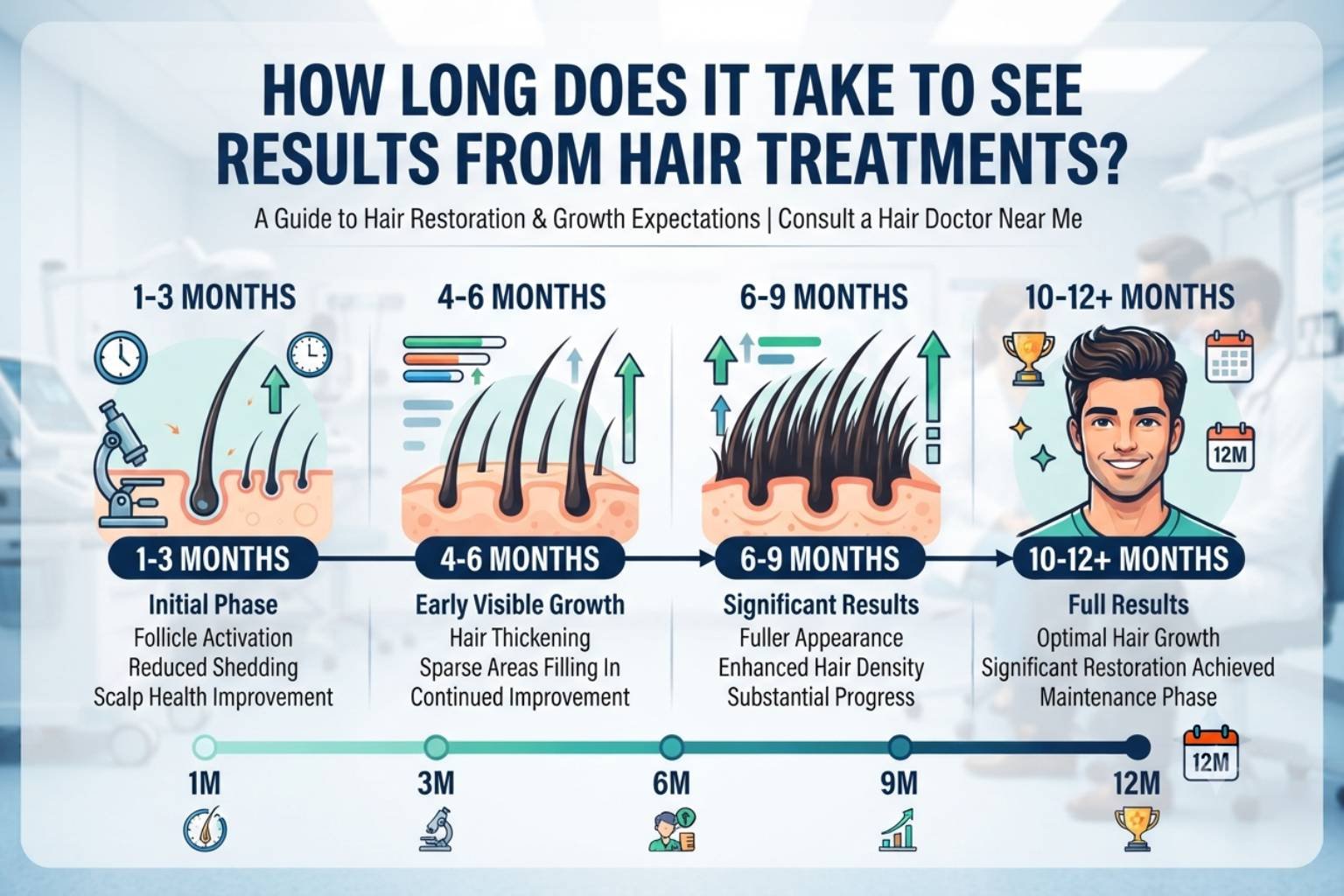
How Long Does It Take to See Results From Hair Treatments?
Starting a hair treatment often comes with one immediate question: when will you notice a difference? The answer depends on the cause of hair concerns, the treatment being used, and how quickly your hair responds. It may take several weeks to see some improvements, and several months to see significant regrowth. Consulting a hair doctor near me can help establish realistic expectations based on your individual condition.
Why Hair Treatments Take Time
The hair follicles have a natural growth cycle, which involves active growth, transition, and rest. Therapies aimed at facilitating growth should be in harmony with this biological process. As a result, changes in shedding or density rarely happen overnight.
The timeline also varies according to the reason behind hair loss. Stress-related or illness-related temporary shedding can be resolved differently than pattern hair loss or scalp disorders. A hair doctor near me can evaluate the likely cause and explain what type of improvement may reasonably be expected.
Early Changes May Not Be Visible
In the initial weeks, therapy can be more about the scalp environment or excessive shedding than actual regrowth. You might notice reduced scalp irritation, less breakage, or changes in how much hair appears during washing.
These minor variations may be challenging to gauge unless they are monitored over time. A more objective comparison can be made by taking photographs under similar lighting every few weeks. Avoid judging treatment effectiveness solely by daily hair fall, since normal shedding naturally fluctuates.
Three Months Can Bring Noticeable Progress
In most hair-growth therapies, three months can be a more significant timeframe to gauge initial improvement. Existing hairs may appear stronger, while some follicles may begin producing new growth depending on the treatment and underlying condition.
However, individual results can differ considerably. Some people respond sooner, while others require more time before visible changes become apparent. In case of minimal improvement after a decent treatment period, a follow-up with a hair doctor near me can be used to establish whether the strategy should be modified.
Six Months Often Gives a Clearer Picture
Six months later, the alteration in density and hair quality can be more easily identified when a treatment is effective. Newly growing hairs can gradually become longer and more noticeable, although they may initially appear finer than surrounding strands.
The consistency is also significant at this stage. Absence of treatments often or early termination may complicate the process of knowing whether the strategy is yielding results. Frequent appointments may assist in monitoring progress and determining whether the treatment should be continued.
Some Treatments Require Longer
Certain procedures and treatment plans need extended periods before their full effects become apparent. An example is hair transplantation, which has an initial shedding period and a progressive new growth. The final appearance develops progressively rather than immediately after the procedure.
Likewise, therapies that consider nutritional deficiencies or underlying scalp issues can be time-consuming since the underlying issue should be rectified. A qualified hair doctor near me can explain the expected timeline for the specific treatment being considered and distinguish normal progress from signs that require reassessment.
Why Consistency Matters
Hair treatments are usually effective when applied as per the instructions of a professional. Applying a product inconsistently or changing treatments frequently can make results harder to evaluate. It can also enhance the chances of irritation or unwarranted side effects.
Allow a treatment time to prove whether it is working unless you have alarming reactions. Keep track of changes in shedding, thickness, texture, and scalp symptoms. If you’re unsure whether your progress is appropriate, an assessment from a hair doctor near me can provide useful guidance.
When Should You Reconsider Your Treatment?
No improvement does not necessarily imply that hair treatment is not effective. The initial diagnosis might require re-evaluation, or there might be another cause of continued shedding. Certain types of hair loss may also not respond to some treatments.
If shedding continues, bald patches develop, or your scalp becomes painful, inflamed, or unusually sensitive, schedule a professional evaluation. A specialist will be able to analyze your history, look at the scalp, and decide whether further testing or another treatment method is required.
Final Words
Restoration of hair is not an overnight miracle but a gradual process. Early improvements may involve reduced shedding or healthier-looking strands, while visible regrowth and increased density often require several months. Instead of paying attention to changes daily, monitor progress over a longer period and adhere to your treatment plan.
Ready for Stronger, Fuller Hair? Schedule Your Appointment!